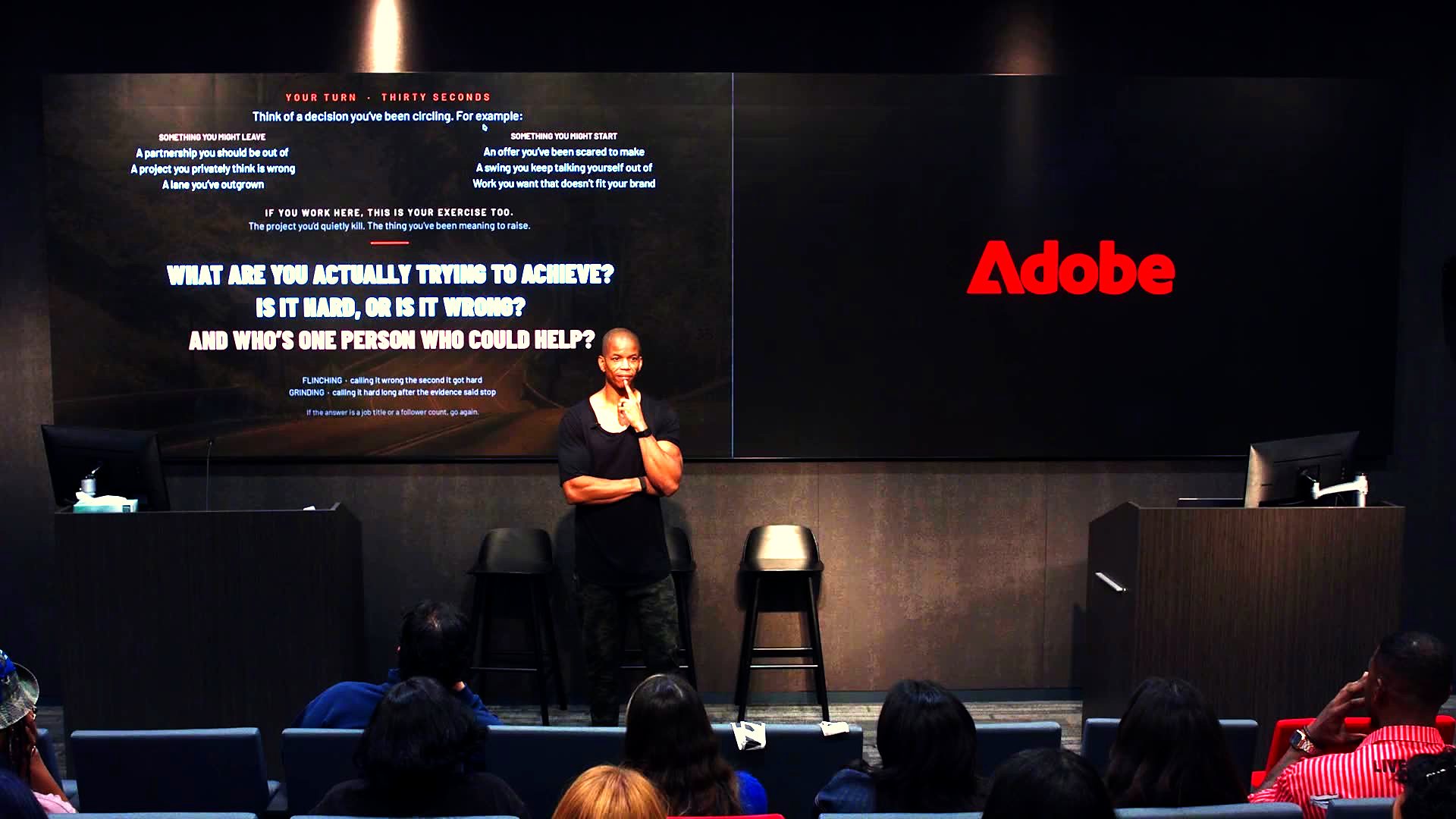
Hard or Wrong
Most keynotes end with a feeling. This one ends with a decision your team has already made.
High-demand periods book 6 to 12 months out.
"I had no idea he was improvising. He'd absorbed what they were dealing with and wove it into the talk on the spot. But what stayed with me was what happened during the session itself. People built actual tools on their phones. Not demos. Not examples. Working tools they walked out with and used the next morning. He even sent them home with homework. Months later, people from that session are still talking about what they built. That does not happen after a keynote."
Your people can't tell the hard calls from the wrong ones.
Every leader in your audience is carrying a decision they've been avoiding. A project that might be dead. A change that might be premature. A person who might be in the wrong seat.
They haven't decided because the decision hurts, and pain is ambiguous. It's either a warning that says stop, or a toll you pay to keep going. The two feel exactly the same.
So they do what smart people do with ambiguity. They wait. And waiting is the one answer that's always wrong.
This is not a talk. It's a live demonstration of the argument.
Halfway through the session, every person in the room pulls out their phone. They scan a QR code and run a real decision, one they name themselves, through the test.
Before the event, a stakeholder names a real initiative the team is stuck on. During the event, the room runs it together. Question by question, evidence state by evidence state, until the move is obvious.
That moment, when a decision the team has circled for two quarters resolves in twelve minutes, is not a party trick. It's the entire argument made real. Gartner's research shows up to 70 percent of learned skills are never applied on the job without immediate practice. So the practice happens in the room.
Three questions. Three evidence states. Four outcomes.
- Question 1What am I actually trying to achieve here? Half the time, naming the goal ends the decision on the spot.
- Question 2Is this hard, or is it wrong? Settled by evidence: Avoidance means go get the fact. Experiment means run the smallest reversible step. Values means set a decide-by date and ask who you want to be.
- Question 3What's the move? Wrong goal: drop it now, not in six months. Wrong approach: keep the goal, change the road. Just hard and not yours: hand it off. Just hard and yours: push, with the whole team behind it.
Then the honesty check. There are two ways to cheat the test. Flinching: calling it wrong the second it gets hard. Grinding: calling it hard long after the evidence said stop. Your team learns to name both, in themselves and each other.
Could your team disappear for a week?
Here's a diagnostic that runs through everything. Could your key people go away for seven days right now? Not check in. Not respond. Just go?
If the answer is no, they haven't built what they think they've built. They've built a job that requires them to be there for it to keep running. That's dependency dressed up as achievement.
The comfort tax works the same way. Every hard redesign you avoid because it's hard, not because it's wrong, bills you later. Quietly, and with interest. The test is how you stop paying it by accident.
A thousand hours before the first stage fee.
When Terry started his business he had a newborn daughter and no safety net. General Assembly gave him the reps. At his peak he was leading three or four workshops a week, sometimes with material he got the night before.
Some of those rooms were mandatory 9 a.m. trainings for executives who did not want to be there. His job was to make it worth their time anyway. That's where he learned to read a room, bring the energy when nobody else did, and keep people engaged for eight hours because his family was depending on it.
Ten years later, people still tell him they remember a workshop he ran at General Assembly or NYU. That's the standard. It hasn't moved.
A one-man show.
No slides. No clicker. Terry walks the stage for 45 to 60 minutes telling stories. Real ones, with real losses and real rebuilds. The fired-from-Facebook rebuild gets seven to nine minutes, told with weight.
The keynote runs in two movements. The first half is the story and the test, the questions that land differently once someone has been feeling them but couldn't name them. The second half is the experience: phones out, a real decision on the screen, the room running the test together.
They don't leave with a slide deck. They leave with a framework they can run in Monday's 1:1s, a card in their pocket, and a decision they already made.
Straight from the conference floor.
Attendees on camera, minutes after the session ended.
What people say after.
Not inspiration. Three things that work on Monday.
The test, in their pocket
The Hard or Wrong card for every attendee, plus a manager version built for 1:1s and performance conversations.
A decision they already made
Every person runs one real stuck decision through the test during the session. They don't leave planning to use it. They've used it.
One question they won't stop thinking about
Are you building the life you want, or managing the one you ended up with?
What you need to know.
- Pre-event call. Terry gets on a call with your team to understand your audience, goals, and context.
- Audience diagnostic. He talks to attendees beforehand and weaves their real situations into the keynote.
- Interactive setup. A QR code and URL your team drops into the slides. No app, no account, no IT approval.
- Post-event resource. Every attendee leaves with the card and the 30-day follow-up worksheet.
- Reputation-safe. Content aligned in advance, no surprises on stage, responsive from first call to final follow-up.
One page. Everything your committee needs to say yes.
What planners ask.
Does the interactive part need IT approval?
No. Attendees scan a QR code and open a web page. No app, no accounts, no data collected beyond the session.
Can he customize it for our industry?
That's the default, not an add-on. Terry runs a pre-event call and talks to attendees beforehand, then weaves their real situations into the keynote. No two rooms get the same talk.
Virtual or in-person?
Both. The interactive segment works identically on a stream, and virtual sessions get the same pre-event diagnostic.
How far out should we book?
High-demand periods book 6 to 12 months out. If your date is closer, ask anyway. Openings happen.
What does it cost?
Fees depend on format, timing, and location. Book a thirty-minute call and you'll have a custom proposal within 48 hours.
Bring Hard or Wrong to your event.
Terry takes a limited number of keynote dates each quarter, and high-demand periods book 6 to 12 months out.
One call, thirty minutes. If it's not a fit, you'll know before the call ends.
Prefer email? terry@terryrice.co